
BELOIT
Conservationist Kevin Kawula snapped off an invasive European buckthorn branch hanging over a hiking path at Big Hill Park and tossed it over an electric fence encircling an overgrown 1-acre prairie plot.
The branch landed among a herd of spiral-horned goats quietly grazing in the fenced area.
Three goats startled, then regarded the buckthorn sprig with unblinking eyes that had coin slot-shaped pupils.
One goat grunted, raising the attention of a squadron of about 25 others. The goat bleated. Then it and about 15 other goats raced to the felled branch, descending on it from all sides. A frenzy of gnawing, gnashing goat teeth tore away bark, leaves and berries.
This was not the goat-zombie apocalypse.
But staff at the Welty Environmental Center at Beloit鈥檚 Big Hill Park hope that a tribe of 70 goats-for-hire will inflict a grisly death upon invasive plants that have weakened and altered the park鈥檚 native prairie ecosystem.
Brenda Plakans, Welty鈥檚 executive director, is in charge of the goat-grazing pilot program funded by patrons and donors to her nonprofit education and conservation group. She has organized a t, a Monroe-based company that hires out goats as a biological control tool.
The goats will be at the park to eat鈥攁nd ultimately weaken and destroy鈥攄ozens of varieties of tall, brushy invasive plants that have been here since Wisconsin鈥檚 earliest settlers introduced them as medicinal plants, landscaping and animal fencing barriers in the mid-1800s.
The invasives鈥攈oneysuckle, buckthorn, multiflora roses, garlic mustard, wild parsnip and a slew of rash-inducing ivies and sumacs鈥攈ave worked for decades to overtake trees and native grasses that otherwise might thrive at Big Hill Park.
The park is on a high bluff along the Rock River just north of Beloit. The bluff itself is an outwash area, a geological formation created when glaciers moved in and receded in southern Wisconsin, pushing and pulling deposits of sand, gravel and fertile prairie soil into large hills.

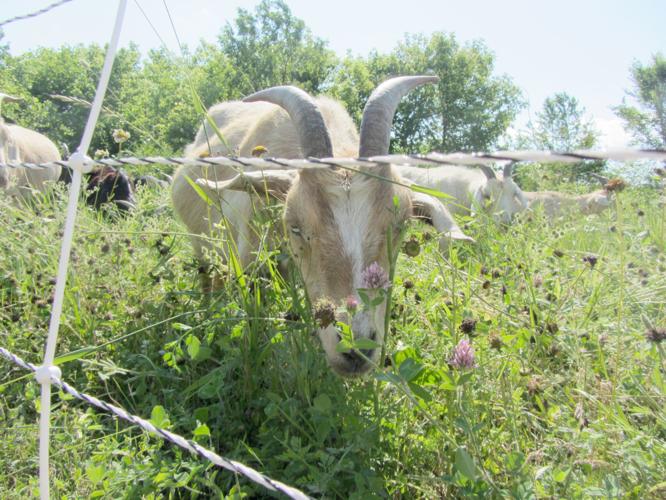
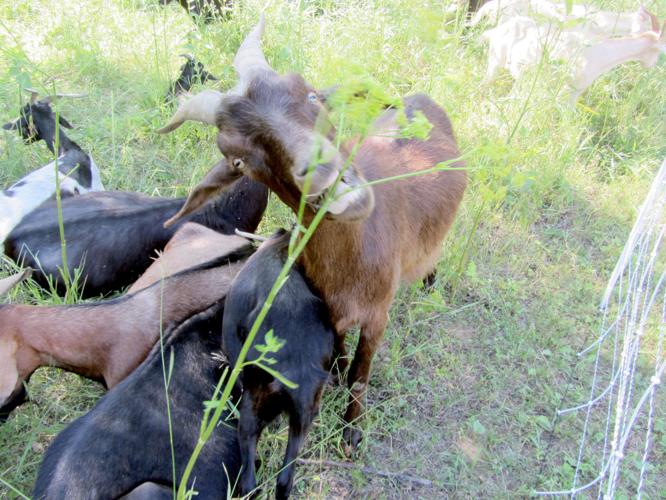
One of a herd of 70 goats grazes on an invasive wild parsnip in a paddock of fenced-in prairie at Big Hill Park in Beloit. Welty Environmental Center, which operates in the 190-acre park, is using the goats to help clear invasive plants that are taking over the prairie.
鈥淭he research we鈥檝e done shows that the prairie here at Big Hill really is an oak savanna prairie, which is a mix of native prairie grasses and trees. But it鈥檚 not really been that for decades,鈥� Plakans said.
Over the prior century, much of Big Hill鈥檚 prairie was cleared for farming. It returned to its natural state over the last few decades. Plakans and Kawula, a member of the Rock County Conservationists, said Big Hill鈥檚 return to a prairie has been hindered partly because invasive plants got a foothold.
The invasives begin by forming small, brushy areas, but they quickly take over and crowd out other plants, creating thickets of weeds, thorns and noxious plants that are difficult to remove.
Kawula said the non-native plants also have altered the soil鈥檚 chemistry, which can make it harder for native plants to thrive.
The grazing goats from Green Goats might be able to help change that.
In a few acres of prairie near the Welty center, a former Girl Scout facility, Plakans and volunteers have set up electric fencing around an area full of non-native bushes, scrub ivy and overgrown saplings.
Green Goats鈥� owner, Kim Hunter, brought in her herd of goats this week, and the goats immediately turned the area into a grazing paddock.
The Welty center learned about the goats after Alliant Energy hired Green Goats to bring in a tribe of its goats to clear invasive species from part of the Riverside Energy Center in the town of Beloit.

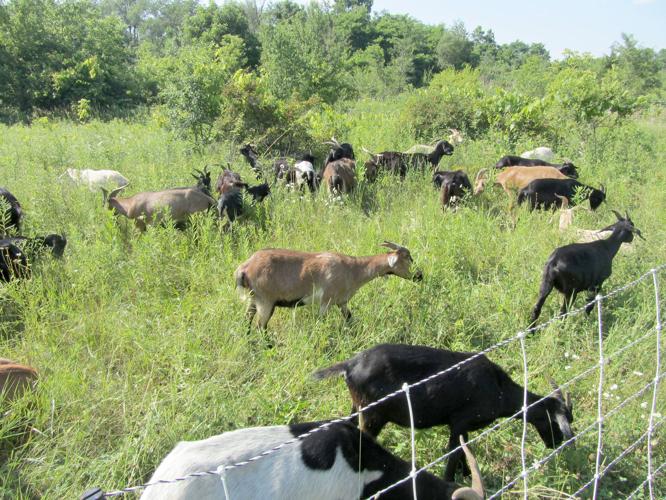
A herd of 70 goats grazes in a 1-acre paddock of prairie at Big Hill Park in Beloit. The goats will be working at the prairie for about two weeks, clearing invasive plants that are hard for humans to remove.
鈥淚t鈥檚 hard to clear the invasive plants by hand, and takes a lot of volunteers to do this work. Plus chemicals. With the goats, there are no chemicals. That fits right along with our mission,鈥� Plakans said.
The goats鈥� first round of work will roll out over the next two weeks. They will trim invasive weeds and eat branches鈥攚ood, bark, everything鈥攆rom the treelike bushes, weakening those plants.
Later in fall, the goats could be back to graze the paddock a second time. That will further weaken the invasive plants, to the point that the native prairie might begin to override the weeds.
The goats鈥� hooves naturally aerate the soil, and their droppings act as a naturally composting fertilizer that Kawula said will help restore the prairie鈥檚 native soil composition.
And unlike other ruminants, goats鈥� teeth thoroughly grind up plant seeds. That means goat manure doesn鈥檛 plant weed seeds that could regrow later.
Plakans said it can cost $3,500 or so for a two-week stint of goat-powered weed eradication, depending on the size of the area the goats must clear and how dense the weed cover is.
So far, the goats have been voracious weed eaters.
This week, they were observed 鈥渃limbing trees鈥� in teams of two or three. That is, the goats were standing on their hind legs and using their forelegs to bend down and snap off the branches of tall buckthorn bushes.
鈥淭hey鈥檝e got a dozen or more invasive plant species to eat. And these plants are native to all corners of the Earth, stuff from Europe and Asia,鈥� Kawula said. 鈥淚t鈥檚 truly an international dining experience for them.鈥�
