

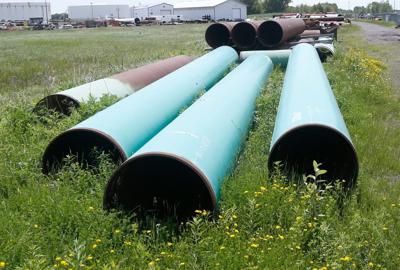
State agencies on Wednesday issued key permits for the controversial Line 5 tunnel in the Straits of Mackinac, concluding the project鈥檚 benefits outweigh drawbacks that include disruption to Native American burial sites and harm to wetlands and rare species.
The permits issued by the departments of Natural Resources and Environment, Great Lakes and Energy also make way for the US Army Corps of Engineers to sign off on the project, which supporters and foes alike expect to happen soon.
The project鈥檚 future remains unclear, however, as other permits remain tied up in state and federal court and one Great Lakes tribe promised a new lawsuit over Wednesday鈥檚 decision.
鈥淓ven in death we cannot know peace,鈥� said Whitney Gravelle, president of the Bay Mills Indian Community, which has vowed to sue. 鈥淲e must still be removed and dug up, and get out of the way for this country, for this state, for these corporations.鈥�
Enbridge Energy spokesperson Ryan Duffy, meanwhile, hailed the approvals as a milestone for a project that will bring worthwhile safety improvements to the Straits while continuing to ensure 鈥渢he uninterrupted flow of energy that supports Michigan and the region.鈥�
EGLE said in a news release that, after 16 months of review, officials concluded 鈥渢he public and private need for the proposed activity outweighed other public interest criteria.鈥�
The EGLE permit, issued under Part 303 and Part 324 of the Natural Resources and Environmental Protection Act, allows tunnel construction that would impact wetlands and the Great Lakes bottomlands, including filling, dredging, altering and placing structures in the water bodies.
About 1.53 acres of wetlands in Mackinac County would be impacted, along with 0.17 acres of Lake Michigan bottomlands in Emmet County where a water intake structure would be built to support tunnel construction.
Soon after EGLE鈥檚 announcement, the DNR announced it had granted a separate permit pertaining to the project鈥檚 impact on rare plants and animals, including the Houghton鈥檚 goldenrod, dwarf lake iris and several bat habitats.
Reached by Bridge Michigan, EGLE spokesperson Dale George said the agency does not have any additional comment on the permit issuance.
In a writeup explaining their decision, EGLE officials acknowledged the project will have 鈥渟ignificant impacts,鈥� including likely impacting threatened or endangered species, disrupting recreation and destroying burial grounds in the Straits, which is a sacred area to Great Lakes Native American tribes.
鈥淭he magnitude of impacts to recognized historic and cultural values of this proposed project exceeds that of any other that EGLE has reviewed,鈥� stated the agency explanation.
But officials concluded the need for the project 鈥� namely, eliminating the 鈥渦nacceptable鈥� oil spill risk posed by the existing lakebottom pipelines 鈥� outweighed its drawbacks and that mitigation measures could help lessen those drawbacks.
Full details of those mitigation measures were not immediately available. The permit states Enbridge must submit mitigation plans to EGLE by year鈥檚 end. The company also must provide a $1.1 million surety bond or letter of credit to ensure mitigation measures will be carried out.
Duffy said Enbridge officials are reviewing permit conditions imposed by EGLE and the DNR 鈥渢o assess any impacts on tunnel construction.鈥�
The decision was met with outrage by Line 5 foes, who said they hold Gov. Gretchen Whitmer personally responsible.
Whitmer campaigned for office in 2018 on a promise to shut down Line 5.
鈥淚t鈥檚 incredibly disappointing that a governor who ran on a commitment to the climate and protecting the Great Lakes has now decided to instead endorse a Canadian industrial tunnel project that still threatens the Great Lakes and will contribute fossil fuels to the climate,鈥� said David Holtz, coalition coordinator for the anti-Line 5 group Oil & Water Don鈥檛 Mix.
Tunnel supporters, including business groups and trade unions whose members would likely work on the massive construction project, cheered Wednesday鈥檚 decisions.
鈥淚t鈥檚 a step towards the kind of energy infrastructure project that means good jobs and affordable energy,鈥� said Brent Pilarski, business manager for the Michigan Laborers District Council. 鈥淢ichigan labor is ready to get to work.鈥�
Enbridge is also seeking a permit to discharge millions of gallons of treated wastewater per day into Lake Michigan during tunnel construction, and EGLE is expected to rule on that request by Sept. 30.
Wednesday鈥檚 permit issuance includes a key Clean Water Act certification needed for the US Army Corps of Engineers鈥� anticipated approval of the tunnel project after years of deliberation.
Last year, the Corps narrowed and sped up its permit review, as it sought to carry out President Donald Trump鈥檚 pro-fossil fuel agenda. An agency analysis raised few concerns about the tunnel project, concluding most impacts would be 鈥渟hort-term with the effects resolving once construction is completed.鈥�
The review was originally supposed to consider climate impacts from a project that would secure decades of continued fossil fuel transports on Line 5, but those plans were axed following a series of Trump that directed the federal government to favor energy developments and downplay climate concerns.
Wednesday鈥檚 decision follows years of fierce public debate over the pipeline, which crosses Michigan as it shuttles 540,000 barrels per day of oil and natural gas liquids from Superior, Wisconsin to Ontario, Canada.
Enbridge first pitched its tunnel plan in response to public fears that the 73-year-old lakebottom pipeline could rupture and cause a catastrophic oil spill in the Great Lakes.
The plan calls for building a concrete-lined tunnel deep beneath the Straits, then decommissioning the 4-mile segment that currently runs through open water and instead routing it underground.
Officials with the company have long contended the tunnel would 鈥渕ake a safe pipeline safer.鈥�
Opponents contend Line 5 should be permanently shut down. They argue the tunnel proposal would create new safety hazards while worsening climate pollution from burning fossil fuels, which is already dangerously heating the globe.
They also contend Enbridge has other ways to transport its petroleum, including unoccupied space on other Enridge-owned pipelines.
Beyond the permit issued Wednesday and the Army Corps permit decision expected soon, Enbridge and pipeline foes are locked in legal battles that have the potential to make or break the tunnel project and decide the fate of the existing pipeline.
1. The Michigan Supreme Court that alleges the Michigan Public Service Commission improperly issued a key tunnel permit in 2023.
2. Meanwhile, the state is battling in court with Enbridge over Whitmer鈥檚 2020 order to shut the existing pipeline down for fear that it could cause an oil spill in the Straits. A federal judge in December that Michigan had no authority to order a shutdown, but the state has appealed the ruling.
3. Separately, Michigan Attorney General Dana Nessel has been seeking a shutdown since 2019 in a case that from state to federal court and back again. The case now sits in the 30th Circuit Court in Ingham County, where deliberations are paused pending resolution of the case stemming from Whitmer鈥檚 shutdown order.
Fears about Line 5鈥檚 potential to rupture in the Straits first emerged after Enbridge鈥檚 Line 6B pipe in the Kalamazoo River near Marshall. Since then, Line 5 has been repeatedly struck by ships鈥� anchors, further heightening concerns.
In response, Enbridge in 2018 struck a deal with then-Gov. Rick Snyder to build the proposed tunnel.
Originally described as a $500 million project that would be complete by 2024, the tunnel is now likely to cost Enbridge in the billions with construction running into 2030.
Enbridge also has a mixed history in Wisconsin, including a 2019 pipeline spill that the company concealed from state authorities and then the public , and a 2024 spill near Cambridge that .
This story was originally published by and distributed through a partnership with The Associated Press.