

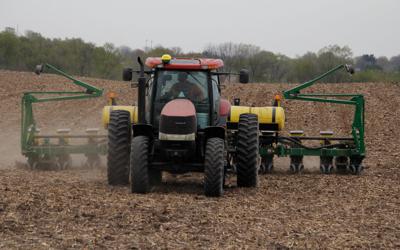

A farmer works in a field off Highway 11 west of 糖心Vlog传媒 Friday, April 26.
JANESVILLE 鈥� After several inches of rain this weekend, 糖心Vlog传媒-area farmers say they鈥檙e hoping for a drier week to continue planting, amid a mild spring and rising temperatures.
Spring planting at W. Hughes Farm, on U.S. Hwy 51 in 糖心Vlog传媒, is on schedule, owner Randy Hughes said. Hughes said he鈥檚 feeling good about the coming season.
As a fifth-generation 糖心Vlog传媒-area farmer, Hughes grows crops such as corn, soybeans, sunflowers, and small grains such as kernza, and provides crops for Seneca Foods Corporation and other local canning companies.
The weekend rain might mean they sit out planting on Monday, 鈥渂ut if the sun shines and the wind blows, we鈥檒l get back to it,鈥� Hughes said. 鈥淭he soil temperatures are good, which is important for germination. So, we鈥檙e happy about that.鈥�
With several hundred acres of soybeans and corn already planted, Hughes said he鈥檚 relieved the soil didn鈥檛 got too cold or wet recently to impact crops, and said early concerns about the soil not having enough frost haven鈥檛 become a significant issue.
鈥淪ometimes the freezing-thawing action helps break the soil up and relieve some compaction caused by heavy equipment,鈥� Hughes said. 鈥淏ut maybe it turned out to be false because things are working out pretty good.鈥�
For 16 years, Tim Wellnitz has managed operations at W. Hughes Farm. He is also president of the Rock County Farm Bureau.
鈥淭he season is shaping up pretty good,鈥� Wellnitz said. 鈥淲e got a jump start last week,鈥� with about 15% of crops in the ground, Wellnitz said.
Wellnitz said he hopes for a drier week to help some low-lying areas.
Growing smaller grains over the winter helps prepare for the spring by preserving the soil from erosion, Hughes noted, and breaks up the pest cycles of the corn and soybean rotation.
Careful timing of spring planting is key, the two said. If crops go in too late, they can suffer later in the season as the days shorten, by not having enough sun exposure to mature and finish.
鈥淲e鈥檙e in a hurry all the time,鈥� Hughes said. 鈥淥nce you get it in and planted, everything is better. Then you move on to the next set of challenges: worrying about weeds and bugs.鈥�
Although Hughes said he recalls no year when nothing was planted, some seasons have been too wet to work well.
鈥淵ou just wait for that perfect day and then you run out there and do as much as you can,鈥� Hughes said.
Arch Morton Jr., of Morton Farms on Avalon Road, in 糖心Vlog传媒, said on Sunday he was waiting for heavy rain to pass before planting. After a cold January but overall mild winter, Morton said he鈥檚 鈥渆xcited to see how things go.鈥�
鈥淚f you get a lot of rain after you plant, the soil can actually make a crust which prevents the seed from popping up,鈥� said Morton, a fourth-generation local farmer. With his brother, niece and two nephews, they manage a crop farm of more than 700 acres that has been in operation almost 100 years, growing corn and soybeans.
鈥淢y brother John and his son do the planting for all of us and in the fall, we work together to harvest it,鈥� Morton said. They also grow alfalfa for hay. Each year, the corn and soybean seeds are rotated. The soybeans provide nitrogen to the soil, 鈥渟o if you follow up with corn, you get nitrogen credit going towards next year鈥檚 corn crop,鈥� Morton said.
Morton is also the District 2 director for the Wisconsin Farm Bureau, representing six counties including Rock, Green, Dane, Sauk, Columbia and Dodge. He says their farm typically plants in late April or early May, and said he hopes to get out into the field this week. Larger farms, such as W. Hughes Farm, may have already planted in part because they have more acreage to cover, he said.
Morton said rain this spring made up for some of the moisture that was lacking in the past few years.
鈥淚t鈥檚 been very dry the past three years,鈥� he said. However, 鈥渂eing a farmer, you just have to take things as they come,鈥� he added.
Rain at the right time is critical, he noted. The corn needs an ample supply in July, as do soybeans in August.
鈥淗aving rain, then heat, then rain again, is ideal,鈥� Morton said.